Maruti Suzuki Ciaz Safety Rating? Is the Maruti Sedan Safe for Families?
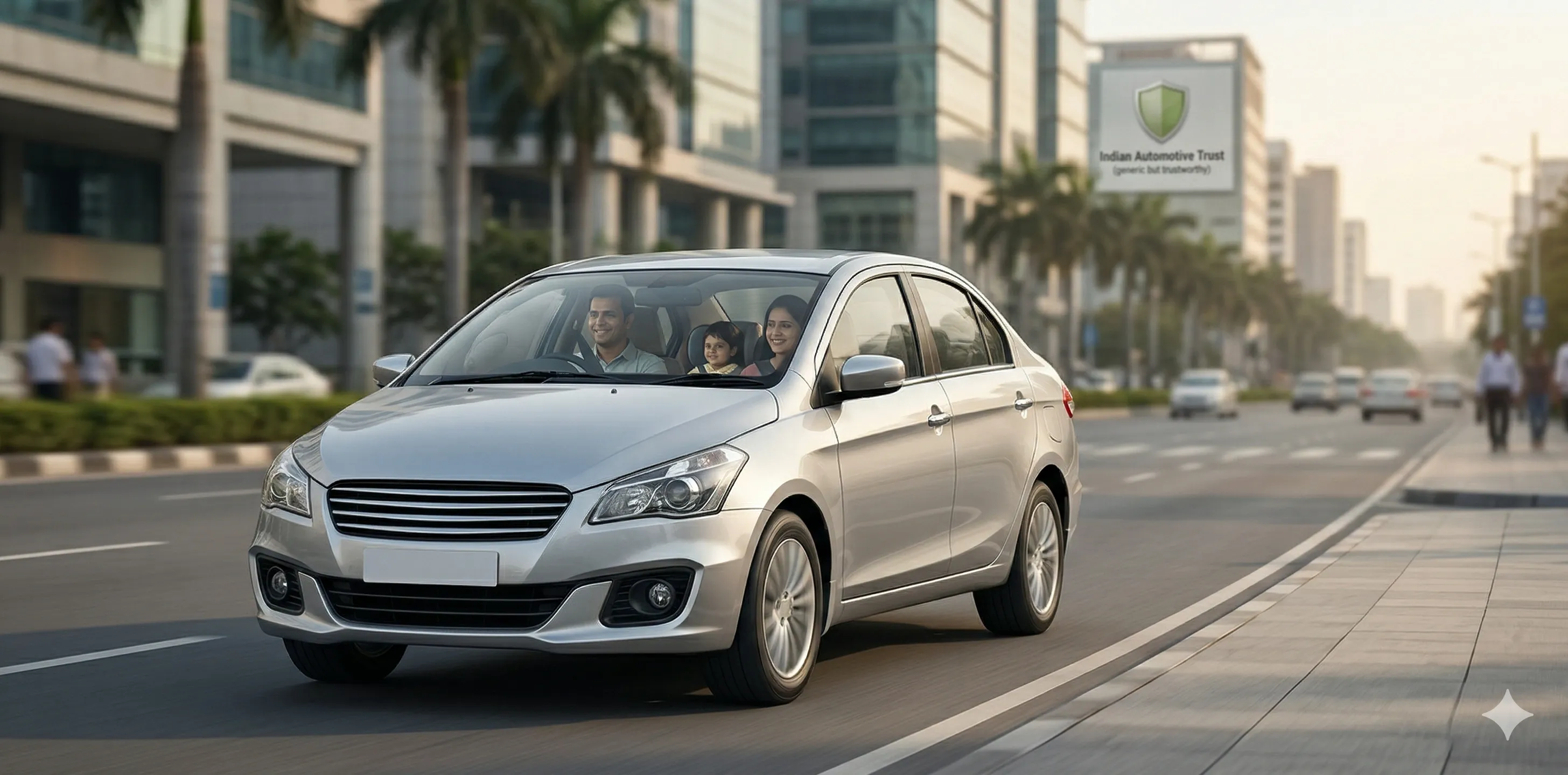
Key Highlights:
- NCAP crash rating is not a legal requirement in most nations, but a voluntary assessment conducted by automotive manufacturers.
- The Maruti Suzuki Ciaz scored an embarrassing 1-star rating in Global NCAP.
- Maruti Suzuki discontinued the Ciaz sedan back in April 2025, owing to poor sales.
The Maruti Suzuki Ciaz sedan was discontinued in April 2025 owing to poor sales (in typical Maruti standards), yet it is listed on the official website with original pricing. Surplus Ciaz units are still available at Maruti Suzuki NEXA outlets nationwide. While colour or trim choices might be limited, one could get a good deal on them. A comparatively inferior product is still a great choice at a significantly lower price tag. Let us explore the key highlights of the Maruti Suzuki Ciaz!
Maruti Suzuki Ciaz: NCAP Safety Ratings
Although the wider majority of Maruti Suzuki owners may not be overly concerned about automotive safety, many expected the Ciaz to return at least satisfactory results in Global NCAP, since it was a relatively premium NEXA product. However, the sedan scored very embarrassingly in the updated NCAP test protocols, as of December 2025: 20.86/34.00 (1 Star) in Adult Occupant Protection and 28.57/49.00 (3 Stars) in Child Occupant Protection. The variant tested had only two airbags.
The Ciaz was sold at a time when Maruti Suzuki was constantly being criticised for subpar crash safety ratings across its range. Newer models such as the Dzire and Victoris have scored 5 stars in Bharat NCAP, which is much more aligned to Indian driving conditions and regulations compared to Global NCAP.
Contrary to popular belief, NCAP crash safety tests are not a legal requirement. Manufacturers voluntarily send their products for testing. Of course, a high NCAP rating is a great marketing tag.
Maruti Suzuki Ciaz: Top Features & Highlights
Features and safety equipment were not really the Maruti Suzuki Ciaz’s strong points. It sports a mature styling principle with LED projector headlamps, beige interiors, 16-inch multi-spoke alloy wheels and ample amounts of chrome. On the inside, the Maruti Suzuki features a 7.0-inch touchscreen (supports wired Apple CarPlay and Android Auto), rear AC vents, coloured MID in the instrument console, cruise control, rear reading lamps and a rear sunshade (a rare sight even today). The sedan was available in 10 colour choices as well as a ‘cosmetically sportier’ Ciaz S avatar.
The main highlights of the BS6-compliant Maruti Suzuki Ciaz revolve around its Smart Hybrid Technology. Beyond idle stop/start, it offers torque assist for better acceleration and regenerative braking to support the same.
Maruti Suzuki Ciaz: Specs & Powertrain
In its final form, the Maruti Suzuki Ciaz was powered by a 1.5-litre K15 Smart Hybrid 4-cylinder NA petrol engine good for 104.6ps @ 6,000rpm and 138Nm @ 4,400rpm. This is mated to either a 5-speed manual or a 4-speed torque converter. In older BS4 format, the sedan was available in a 1.3-litre Smart Hybrid DDIS 4-cylinder diesel (based on Fiat’s 1.3 Multijet), good for about 90ps @ 4,000rpm and 200Nm @ 1,750rpm while mated to a 5-speed manual.
Interestingly, later BS4 models were offered with a 1.5-litre E15A DDIS 4-cylinder diesel format as well. Developed in-house, this unit churned out roughly 95ps @ 4,000rpm and 225Nm @ 1,500rpm while coupled to a 6-speed manual. The diesel Ciaz iterations never had an automatic transmission.
Maruti Suzuki Ciaz Diesel: What Happened?
Maruti Suzuki discontinued its entire 1.3-litre diesel line-up ahead of the shift to BS6 emission norms in 2020. This is one of the main reasons why sales of Marutis that were once available in diesel avatar, such as the Ciaz and S-Cross, dropped sharply in favour of other BS6-compliant diesel products (especially those from Hyundai). It is worth mentioning that Maruti Suzuki has greatly recovered from the initial drop in diesel model sales from the newer mild hybrid or full hybrid petrol models. On the other hand, a BS6 1.3 DDIS variant would have been a sure success in products such as the Dzire, Ertiga, Brezza, XL6 and especially the Jimny.
Coming to the Maruti Suzuki Ciaz’s 1.5-litre E15A DDIS unit in particular (also powered the Ertiga briefly), the Indian automaker supposedly intended to make it BS6 compatible. The inherent design of the 1.5 DDIS mill was unique yet unnecessarily sophisticated. It had an integrated exhaust manifold (unlike a traditional bolt-on design over the cylinder head) that greatly helps in cooling down exhaust gases. However, this property is more beneficial in petrol engines rather than BS6 diesel power plants, which further employ a Diesel Particulate Filter (DPF) over a Diesel Oxidation Catalyst (DOC).
In BS6 engines, the DPF is subject to high temperatures (more than 1000°C) for ‘regeneration’ or essentially, cleaning by burning. The emissions reaching the DPF should predominantly be gaseous for the best results. Meanwhile, the E15A’s integrated exhaust manifold and cooling jacket design dropped the temperatures substantially to convert the emissions into a predominantly liquid state. The forced DPF regeneration process on liquid pollutants exerts high thermal stress that could lead to hairline cracks, and thus emission leaks and related component failures. A bolt-on exhaust manifold design (as seen in most other 1.5-litre diesel cars today) may have helped Maruti Suzuki comply with the E15A with BS6 norms at some point in the future. As it stands, the company has no intention to bring back diesels. Maruti Suzuki reportedly spent around ₹1000 crore and 5 years to develop the E15A!
The Demise of the Indian Sedan
Ever since the advent of compact crossovers or SUVs, the Indian automotive market seems to have shifted its focus away from the once-aspirational C-segment sedan category. There are presently only a handful of choices in this segment, namely the Honda City, Hyundai Verna, Skoda Slavia and Volkswagen Virtus. The last player to leave this genre is the Maruti Suzuki Ciaz. Will sedans regain their lost glory in the country? Most likely, unless manufacturers stick to selling only raised hatchbacks as compact SUVs. Even the small, affordable Ignis hatchback is a ‘Compact Urban SUV’ in Maruti Suzuki’s eyes.
FAQs
1. Is the Maruti Suzuki Ciaz discontinued?
Maruti Suzuki stopped production of the Ciaz sedan in mid-2025, though surplus units are still available at NEXA outlets.
2. Was the Maruti Suzuki Ciaz diesel BS6-compliant?
The 1.3 DDIS and the bigger 1.5 DDIS diesel engines offered in the Maruti Suzuki Ciaz were phased out ahead of BS6 emission norms.
3. What is the Global NCAP rating of the Maruti Suzuki Ciaz?
The Ciaz scored only 1 star in Adult Occupant Protection and 3 stars in Child Occupant Protection.
4. What is the Bharat NCAP score of the Maruti Suzuki Ciaz?
The Ciaz was never tested under Bharat NCAP protocols.
5. Is the Maruti Suzuki Ciaz a hybrid?
Maruti Suzuki employs a mild-hybrid system in the Ciaz that comprises idle start/stop, regenerative braking and torque assist.