Petrol Car vs Diesel Car: Know the Differences
Key takeaways
● Diesel cars typically cost ₹1 lakh to ₹1.5 lakh more upfront than the petrol version of the same model.
● Diesel often only pays off if you drive more than 1,500 to 2,000 km a month.
● Maruti Suzuki stopped selling diesel cars in India after the BS6 emission norms arrived in 2020.
● Petrol engines are usually quieter and cheaper to service.
Introduction
Walk into any showroom, and the salesperson will ask one question early: petrol or diesel variant? It sounds simple. It rarely is.
The petrol car vs diesel car choice affects your upfront price and your running costs. It also affects what you'll get back at resale. Get it wrong, and you could overpay for years. This guide breaks down the real differences, not just the textbook ones. That way, you can match the engine to how you actually drive.
Difference Between Petrol and Diesel Cars
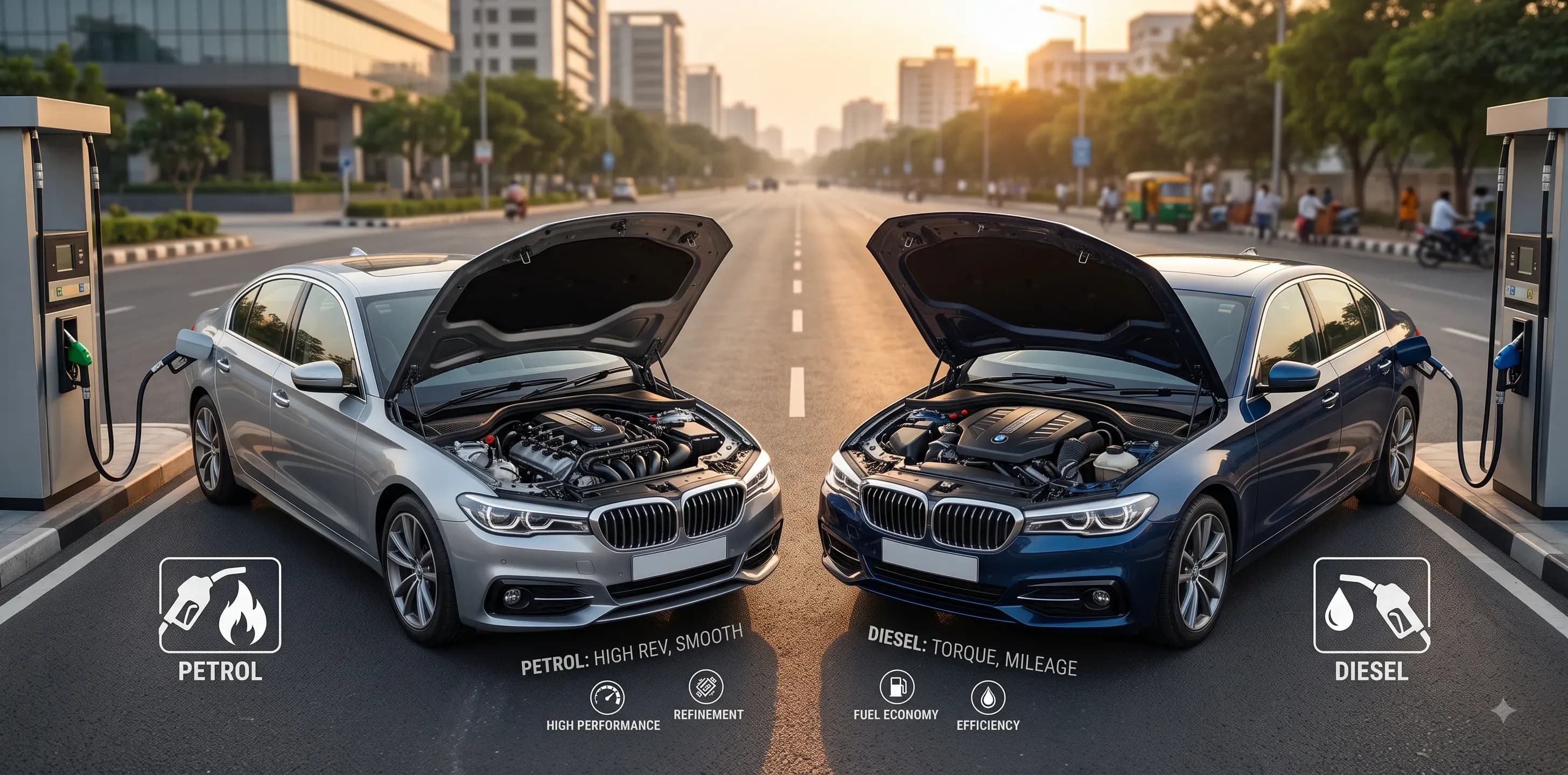
Petrol engines use spark plugs to ignite a fuel-air mix. Diesel engines compress air until it's hot enough to ignite the fuel on its own. That single difference shapes almost everything else.
Diesel engines produce more torque at lower RPM, which is why they tow and climb better. Petrol engines tend to be smoother, quieter, and rev more freely.
| Factor | Petrol | Diesel |
|---|---|---|
| Upfront Price | Lower | Higher |
| Refinement | Quieter and smoother | Slightly noisier |
| Torque | Lower | Higher |
| Mileage (Highway) | Moderate | Better |
| Maintenance | Cheaper and simpler | Costlier and more specialised |
| Resale Value | Stable | Falling, with fewer options in the market |
Advantages and Disadvantages of Petrol Cars
Petrol cars suit most everyday Indian drivers, but they have real limits too.
| Advantages | Disadvantages |
|---|---|
| Lower purchase price | Lower mileage on highways |
| Quieter, smoother engine | Less torque for towing or climbing |
| Cheaper, simpler servicing | Costlier to run at very high mileage |
| Wider model choice | Less efficient for long daily commutes |
Advantages and Disadvantages of Diesel Cars
Diesel cars reward distance, but they ask for a bigger upfront commitment.
| Advantages | Disadvantages |
|---|---|
| Better mileage on highways | Higher purchase price |
| Strong torque for loads and hills Noisier and less refined engine performance | Noisier and less refined engine performance |
| Lower running cost for high-mileage users | Costlier maintenance and spare parts |
| Often commands better resale value, especially for SUVs | Fewer diesel options available after BS6 emission norms |
Petrol and Diesel Price Comparison
Comparing petrol car vs diesel car pricing starts with the upfront difference. Diesel cars usually cost ₹1 lakh to ₹1.5 lakh more than the petrol version of the same model. This gap varies by brand and segment.
At the pump, diesel is typically cheaper than petrol, but the gap shifts often with state taxes and crude prices. Don't assume a fixed difference. Check current local rates before you calculate anything.
Also Read: Car Dashboard Symbols and Meaning
Petrol vs Diesel Car Running Cost
Here's the part that actually decides whether a petrol or diesel car is best for most buyers: how far you drive.
As a rough rule of thumb, diesel pays off only above 1,500 to 2,000 km a month. Below that, the fuel savings rarely cover the higher purchase price.
Petrol cars also tend to need simpler, cheaper servicing. Diesel components like the turbocharger, DPF (diesel particulate filter, which traps exhaust soot), and injectors cost more to maintain.
When Should You Choose a Diesel Car?
A diesel vs petrol car, which is better, depends entirely on your driving pattern. Choose diesel if you drive long distances regularly, especially on highways. It also makes sense if you tow or carry heavy loads.
High-mileage drivers and frequent long-distance travellers will usually get more value from diesel. So will anyone who values torque over refinement.
When Should You Choose a Petrol Car?
Petrol suits most urban, low-mileage drivers better. If most of your driving is short city trips, the lower upfront cost and cheaper servicing usually win.
Petrol also makes sense if refinement matters to you. The same goes if you're eyeing a future hybrid or electric car. If you drive under 1,000 to 1,200 km a month, petrol is almost always the more practical choice.
Also Read: Cars with Panoramic Sunroof
Popular Petrol and Diesel Cars
Which car is best, petrol or diesel, often depends on what's actually available in your segment. Maruti Suzuki stopped selling diesel cars entirely afterthe BS6 emission norms arrived in 2020.
| Segment | Popular Petrol Options | Popular Diesel Options |
|---|---|---|
| Hatchback | Maruti Swift, Hyundai i20 | Limited options post-BS6 |
| Compact SUV | Hyundai Venue, Kia Sonet | Hyundai Creta, Kia Seltos |
| Mid-size SUV | Mahindra Scorpio-N (Petrol) | Tata Safari, Mahindra Scorpio-N |
| Premium SUV | Toyota Fortuner (Petrol) | Toyota Fortuner, MG Hector |
Conclusion: Petrol Car vs Diesel Car, Which Should You Choose?
So, petrol car vs diesel car: there's no universal winner, only a better fit for your driving pattern. Matching the fuel type to your driving habits can improve efficiency, reduce maintenance concerns, and maximise value over the life of the vehicle.
If you cover a serious highway distance every month, diesel earns back its higher price. If your driving is mostly short city runs, petrol is cheaper to buy and to keep running. Work out your real monthly distance before you decide.
FAQs
Which engine is more powerful, petrol or diesel?
Diesel engines produce more torque, which helps with towing and climbing. Petrol engines often produce more raw horsepower and rev higher.
Is a petrol car better for occasional driving?
Yes, for occasional or short-distance driving, a petrol car is usually cheaper to buy, run, and maintain.
Is it worth buying a diesel car?
It's worth it mainly if you drive long distances regularly. Aim for more than 1,500 to 2,000 km a month.
Which gives better mileage, petrol or diesel?
Diesel generally gives better mileage on highways. Petrol can be just as efficient in stop-start city traffic.
Which car has lower maintenance, petrol or diesel?
Petrol cars usually cost less to maintain, since diesel engines have costlier components like turbochargers and particulate filters.