Level 1 Vs. Level 2 ADAS: Features Explained
Key Highlights
- Level 1 ADAS assists a single vehicle system at a time (such as steering or braking), but not simultaneously.
- Level 2 ADAS offers ‘partial automation’ and can control multiple systems simultaneously, but requires continuous driver supervision.
- Level 3 ADAS offers ‘conditional automation,’ wherein the vehicle takes full driving control, but the driver should still take over whenever prompted.
ADAS or ‘Advanced Driver Assistance Systems’ aim to improve automotive safety, comfort and efficiency by assisting the driver in normal driving or during emergencies. Depending on the ‘level’ of sophistication, ADAS employ sensors, cameras and radar to precisely monitor the changing driving environment, while being ready to support or take over a critical function (braking, accelerating, steering or more).
In India, manufacturers are actively integrating ADAS in some format across a wide price range. Besides being an indication of safety, ADAS have become a great marketing tool as well (just like 5-star NCAP ratings). Even cars in the affordable segment have started to receive Level 2 ADAS, while Level 1 ADAS are already the norm in higher trims. This leads to the question: What is the difference between Level 1 and Level 2 ADAS?
Level 1 ADAS Features
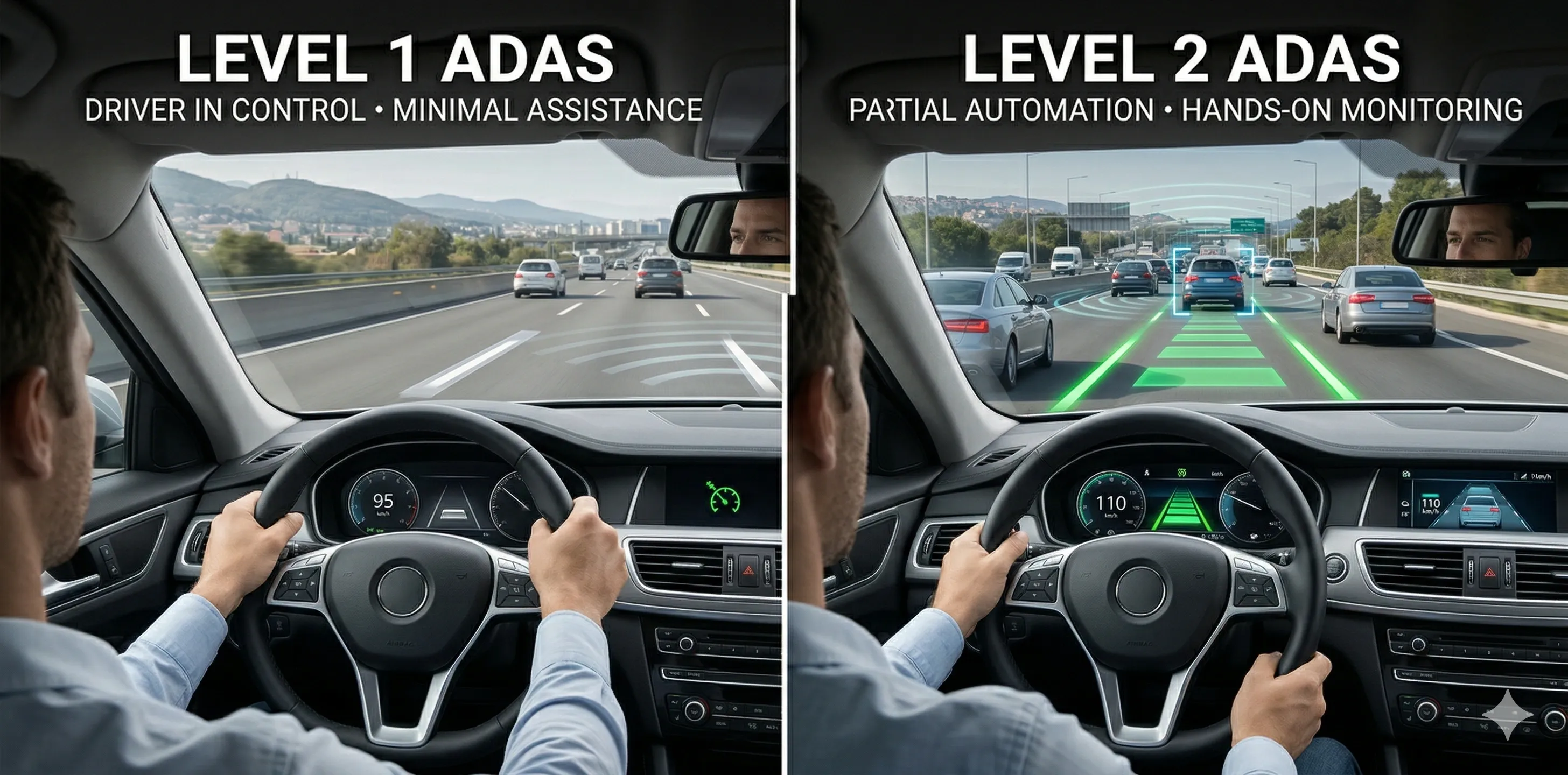
In Level 1 ADAS, functions such as braking, accelerating or steering can be carried out by the system one at a time, and never simultaneously. Popular features coming under Level 1 ADAS include Adaptive Cruise Control (ACC), Automatic Emergency Braking (AEB), Forward Collision Warning (FCW), Lane Keep Assist (LKA) and Lane Departure Warning (with steering input) or LDW.
In an emergency, each of these Level 1 ADAS features works independently, even if they are activated around the same timeframe. For instance, an FCW trigger may occur if a vehicle abruptly merges into the lane ahead, followed by AEB upon detecting the vehicle in closer proximity. In another scenario, when ACC is active on a curve, the vehicle may tend to slightly veer off the driving lane (especially if the lane markings have faded). This activates LDW on its own. Simply put, Level 1 ADAS require the driver to be in full charge while acting as a nudge.
Level 2 ADAS Features
In addition to the capabilities of Level 1 ADAS, Level 2 ADAS offers ‘Partial Driving Automation,’ by being able to perform multiple functions simultaneously. To exemplify, if a pedestrian crosses the road without warning, a vehicle with Level 2 ADAS can detect, brake or sometimes swerve to avoid the pedestrian. The difference between Level 1 ADAS mainly lies in the ability to activate two or more features at once (such as ACC with AEB or FCW + LKA with AEB).
At slow speeds, Level 2 ADAS may not always appear significantly more effective than Level 1. However, the story changes at higher speeds with lesser margins for correction. Popular Level 2 ADAS features range from all the bells and whistles from Level 1, to Lane Centering Assist (LCA), Traffic Jam Assist (TJA), Blind Spot Monitoring (BSM), Driver Drowsiness Detection (DDD), High Beam Assist (HBA), Traffic Sign Detection (TSD) and more. It is worth noting that the driver remains in charge by actively keeping their hands on the steering wheel.
Key Components of ADAS
In the case of Level 1 and Level 2 ADAS, the basic components are similar, although the latter pack more of them in higher formats along with the support of advanced software. The list of components generally includes:
- Multiple cameras (identify lane markings, read traffic signs, and actively monitor surroundings)
- RADAR (Radio Detection & Ranging)
- LIDAR (Light Detection & Ranging)
- Ultrasonic sensors (such as parking sensors)
- GPS
- Dedicated ECU
- Actuators (physically do the intended action, such as braking, steering or throttle input)
- System Integration (messages/signs in the instrument console or HUD, beeps, warning lights, steering wheel vibratory feedback, etc.)
Level 1 & Level 2 ADAS: Main Differences
To state in the lightest form, Level 2 ADAS are more advanced since they can control multiple functions at a time (steering with braking or steering with acceleration). Here’s a quick overview:
| Level 1 ADAS | Level 2 ADAS |
|---|---|
| Controls only one function at a time Easier integration Activation feels intermittent or stepped Basic ECU Lower costs (hence, becoming standard fitment lately) Less maintenance required Vehicle parts cost less than those with Level 2 ADAS The driver remains in control of the vehicle Can be switched off entirely | Can control multiple functions simultaneously Complex integration due to more equipment Feels more natural from the driver’s perspective ECU requires more processing power Higher cost (hence, limited to higher trims presently) May require more maintenance in the long run Vehicle parts cost may be higher (ORVMs with cameras, IRVMs with cameras, front bumpers with radar, etc.) Offers partial driving control, but only with constant driver supervision Impossible to switch off entirely in certain cars |
Higher Levels of ADAS
Many luxury cars sold in India feature Level 3 ADAS or ‘Conditional Driving Automation’. Unlike Level 2 ADAS, which offer ‘hands-off’ driving to a certain extent, Level 3 ADAS enable ‘eyes-off’ driving in specific scenarios. Such vehicles can comfortably drive on their own in slow-moving city traffic, well-marked roads with disciplined traffic, parking lots and to an extent, gated communities. The driver can take their attention away from the road ahead for a considerable amount of time, but should be ready to take over whenever the system prompts (usually occurs when surrounding conditions change abruptly).
Globally, only a few vehicles offer Level 4 ADAS or ‘full automation within a range of conditions and specific locations’. This capability is also dubbed ‘High Automation’ — the driver can sit back and relax; the car drives on its own with or without passengers. As an industry benchmark, US-based ‘robotaxi’ company Waymo (previously known as the Google Self-Driving Car Project) operates a fleet of customised, Level 4 ADAS-capable Jaguar I-PACE all-electric crossovers.
Theoretically, Level 5 ADAS features ‘Full Automation’ in all conditions and locations. This technology does not exist at the moment. Ironically, a hired driver is a primitive yet more capable alternative to Level 5 ADAS.
A Supporting Hand is Not an Excuse
ADAS features have come a long way since their introduction as a basic cruise control module decades ago. Yet, the technology has still got a long way to go before it can truly guarantee safe, adaptable, driverless travel. Good traffic discipline, well-established road infrastructure and general awareness are crucial for effective ADAS implementation at higher levels. Needless to say, these criteria are suboptimal on Indian roads.
Even in ultra-premium Level 3 ADAS cars, the driver should not entirely trust the system, especially in our country. ADAS (unless Level 4) should always be considered as a supporting hand rather than an intelligent servant.
Remember: If an accident occurs due to a car’s apparent operation, the blame almost always falls on the one in the driver’s seat and not the technology.
FAQs
1. What is Level 1 ADAS?
Level 1 ADAS assists a single function at a time, such as steering or braking, and not both simultaneously.
2. What is Level 2 ADAS?
Level 2 ADAS can control steering, throttle input and braking simultaneously, but under continuous driver supervision.
3. How effective is ADAS in Indian traffic conditions?
ADAS pose limitations depending on lane discipline, unclear road markings, mixed traffic and unpredictable driving behaviour (a common sight on Indian roads).
4. Does ADAS increase vehicle prices drastically?
Cars with Level 2 ADAS require more sensors, cameras, radar units and computing power, making them more expensive than those with Level 1 ADAS.
5. What is the future of ADAS adoption in India?
ADAS adoption will rise steadily. Level 1 may become mainstream while Level 2 develops gradually with improving road infrastructure, awareness and updated regulations.