Types of Car Transmission Explained
Key takeaways
● Manual transmissions are generally the cheapest to maintain and the simplest mechanically.
● Torque converter automatics and CVTs feel smoothest in heavy, stop-start traffic.
● Dual-clutch transmissions shift fastest but can feel jerky at very low speeds.
● AMT brings automatic convenience at a lower price, with a slight pause between shifts.
Introduction
Every car gets its power to the wheels somehow, but not every gearbox does it the same way. Understanding the types of car transmission helps explain why two cars with similar engines can feel completely different to drive. Some shift quickly and sharply. Others prioritise smoothness over speed.
Many buyers also search simply for types of transmission when comparing cars before a test drive. The five main categories cover almost everything on sale today. This guide breaks down each type, what it's actually for, and how to choose between them.
Types of Car Transmission
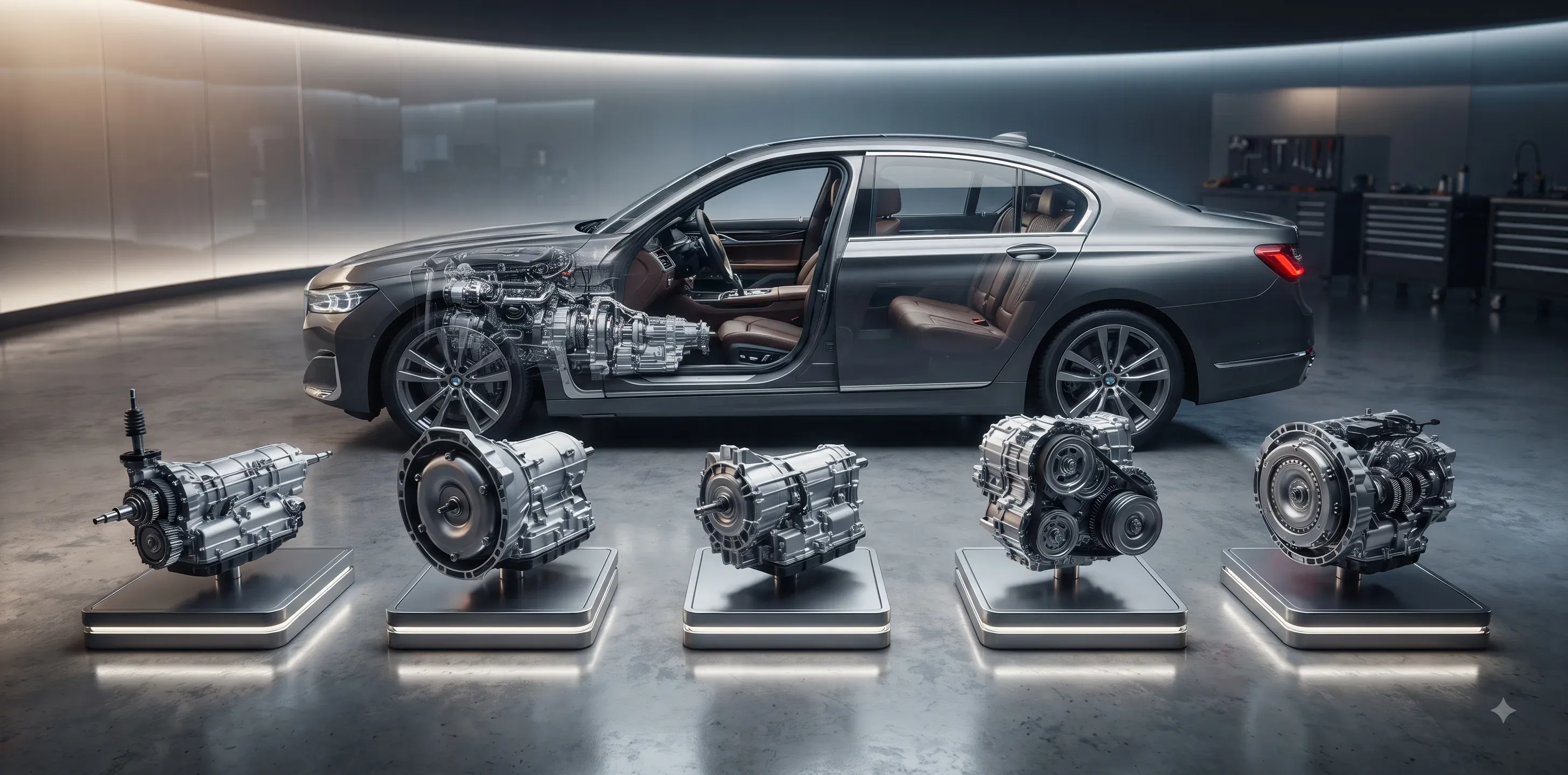
There are five car transmission types you'll commonly come across in cars sold today.
Manual transmission
A manual transmission uses a clutch pedal and gear lever, giving the driver direct control over every gear change. It's mechanically simple, which keeps repair costs low. The trade-off is more effort required in heavy traffic, since there's no automation involved at all. Many enthusiasts still prefer it for the extra control it gives over engine behaviour.
Torque converter automatic
This is the classic automatic, using a fluid coupling instead of a mechanical clutch. It shifts gears smoothly without any driver input. Torque converter automatics are common in SUVs, sedans, and MPVs, prized for their relaxed, unhurried character.
CVT transmission
A CVT uses a belt-and-pulley system instead of fixed gear steps, giving continuous ratio changes. Power delivery feels smooth rather than stepped. Some drivers notice a "rubber-band" sensation under hard acceleration, though modern CVTs simulate steps to reduce this.
Dual-clutch transmission
A dual-clutch transmission uses two clutches to pre-select the next gear before you need it. Shifts happen almost instantly, which suits spirited or highway driving well. At very low speeds, it can feel slightly jerky compared to other automatics. This trade-off matters most if your daily drive is mostly stop-start traffic.
Automated manual transmission
An AMT is essentially a manual gearbox with actuators handling the clutch and gear changes for you. It brings automatic convenience at a lower price than other options. The trade-off is a noticeable pause between shifts, especially under hard acceleration. It's a common choice in budget cars where cost matters more than refinement.
Also Read: Cheapest Cars in India
Main Functions Of Transmission
A transmission does more than just change gears. It transfers engine power to the wheels, adjusts speed and torque to match driving conditions, and enables reverse. It also helps keep the engine running in an efficient RPM range. That supports both fuel economy and long-term engine health.
Also Read: Types of Car Suspension
Choosing the Right Transmission
The right transmission depends on a few practical factors, not just personal preference.
Power Transfer
How efficiently a gearbox sends engine power to the wheels affects how direct or relaxed the car feels to drive.
Speed and Torque Controlling
Different transmissions manage torque and speed differently at various RPMs, shaping how quickly and smoothly a car accelerates.
Fuel Efficiency Enhancement
Transmissions like CVTs and modern automatics with more gear ratios help engines stay in their most efficient RPM range. That translates into better real-world mileage.
Engine Longevity
Smooth, well-timed gear changes reduce unnecessary strain on the engine, which can support longer-term reliability with proper maintenance.
Driving Comfort and Control
Automatics ease the mental load of city traffic, while manuals give enthusiasts more direct control. The right choice depends entirely on your daily driving conditions.
Conclusion: Types of Car Transmission, in Short
So, the types of car transmission boil down to one trade-off: convenience versus direct control. If you drive mostly in traffic, an automatic, CVT, or AMT will likely suit you better. If you enjoy driving itself, a manual still has a strong case. Test drive a few options before deciding, since the difference is easier to feel than to read about.
The right transmission can improve fuel efficiency, reduce driver fatigue, and help minimise long-term maintenance expenses.
FAQs
Which transmission type lasts the longest?
Manual transmissions are the simplest mechanically and often last longest, though well-maintained automatics are also durable.
Is CVT better than an automatic transmission?
A CVT is itself a type of automatic transmission. Compared to a torque converter automatic, it often gives better mileage but feels different under hard acceleration.
Are manual cars cheaper to maintain?
Generally, yes, since manuals have fewer complex components that can fail or need costly repairs.
Is a dual-clutch transmission good for daily driving?
It works well on highways and open roads, though it can feel less smooth in heavy, low-speed city traffic.
What transmission is best for stop-and-go traffic?
Torque converter automatics and CVTs typically feel smoothest in heavy traffic. AMT can feel jerkier by comparison.
Can transmission type affect resale value?
Yes. Well-regarded automatics often hold resale value better, while manual and AMT resale depends more on buyer preference.