8 Types of Car Suspension
Introduction
A car’s suspension rarely gets showroom attention. Touchscreens do. Panoramic sunroofs certainly do. But the suspension system decides something far more important; how a vehicle behaves after 40,000 km on broken city roads, uneven highways, flooded streets, and expansion joints that punish poorly engineered setups.
That’s why understanding the types of car suspension matters far beyond enthusiast conversations. Ride quality, tyre wear, cabin comfort, fuel efficiency, handling stability, and long-term maintenance costs all connect back to suspension architecture.
In India, the discussion becomes even more relevant. For instance, a hatchback driven daily through Bengaluru traffic requires a very different setup from an SUV tackling rural roads in Tamil Nadu or Rajasthan. Manufacturers tune suspension systems according to market priorities: comfort, durability, cost control, or dynamic performance.
Here’s the reality. No single setup is perfect. Every suspension design involves compromise. And that’s exactly why buyers should understand the major types of car suspension before signing a loan agreement that may run for 7+ years.
Types of Car Suspension Systems
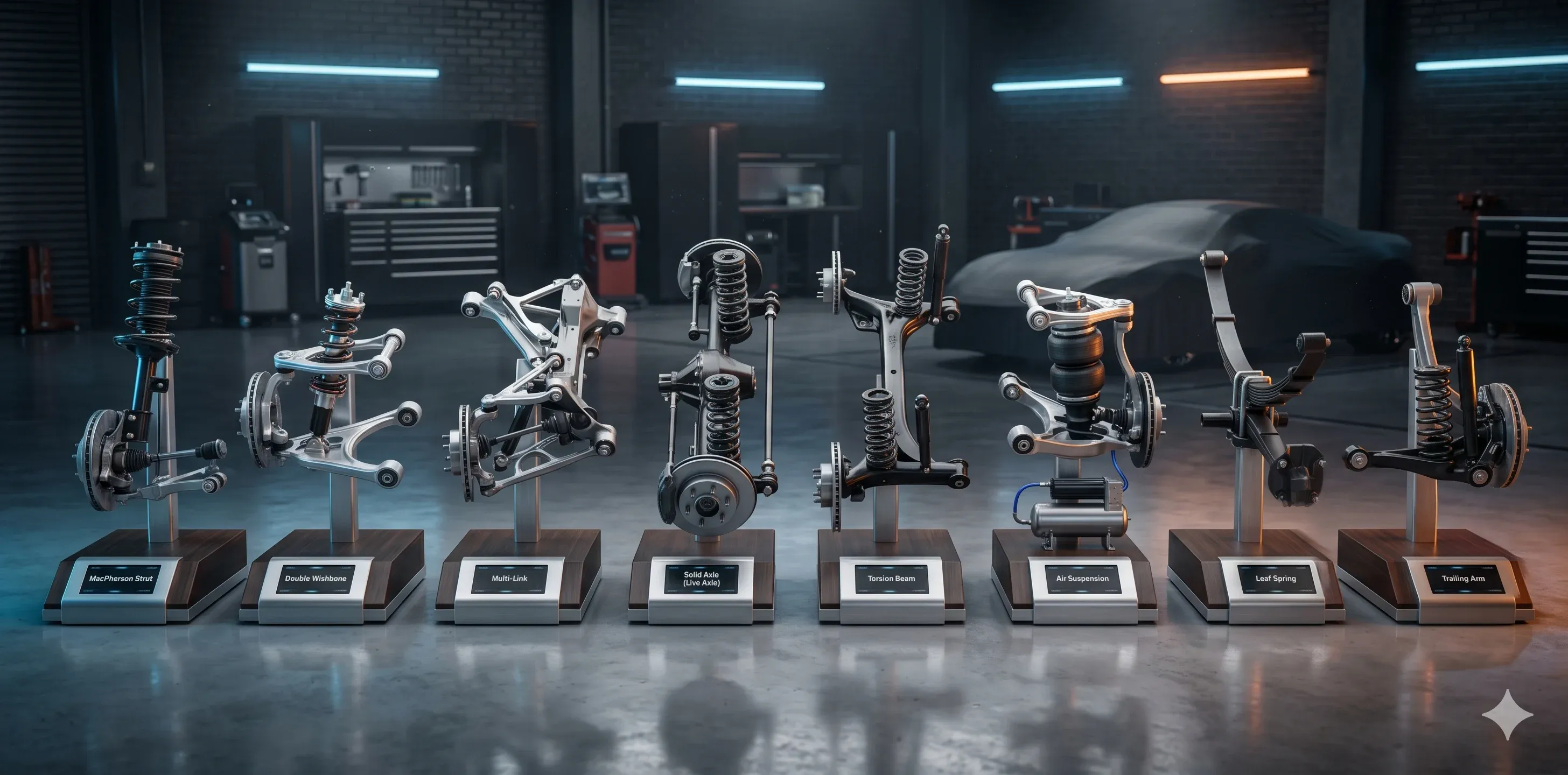
Modern vehicles use different layouts depending on vehicle weight, intended usage, and pricing strategy. Some prioritize handling precision. Others focus on affordability and load-bearing ability. These are the most widely used types of suspension systems in today’s passenger vehicles.
1. MacPherson Strut Suspension
Among all types of car suspension, the MacPherson strut remains the industry standard for front-wheel-drive cars. Compact, affordable, and relatively lightweight.
It combines a shock absorber and coil spring into a single assembly. That design reduces manufacturing complexity while freeing up engine bay space.
Most Indian hatchbacks and compact SUVs use this setup because it balances:
● Cost efficiency
● Ride comfort
● Ease of maintenance
● Acceptable handling characteristics
Think of cars like the Hyundai Creta or Maruti Suzuki Baleno. Their suspension tuning focuses less on racetrack sharpness and more on pothole absorption and passenger comfort.
A workshop technician once described it bluntly during a suspension rebuild in Chennai: “Customers complain about mileage figures. But after driving on bad roads daily, most secretly care more about comfort than cornering speed.”
That statement explains why MacPherson setups dominate Indian roads.
2. Double Wishbone Suspension
This design uses two control arms shaped like wishbones. More components. More precision. Higher cost.
Double wishbone-type suspension is one of the best types of car suspension and provides the best control of the wheels in cornering and braking. The contact of the tyre is more consistent, which enhances stability at higher speeds.
This configuration is used on performance-oriented sedan and SUVs because it provides:
● Better cornering balance
● Reduced body roll
● Improved steering response
However, there is a downside. More bushings and joints increase maintenance costs.
For example, an SUV like Toyota Fortuner is equipped with the double wishbone front suspension to deliver excellent handling and tire control whilst retaining the strength and rigidity required for the harsh Indian road environment and heavy loads.
3. Multi-link Suspension
Sophisticated. Expensive. Highly effective.
Multi-link layouts use multiple arms to manage wheel movement independently. This allows engineers to fine-tune ride comfort and handling simultaneously.
Among advanced types of car suspension, multi-link systems are common in luxury sedans and premium EVs (like Hyundai Ioniq 5, Tata Harrier for example) where cabin refinement becomes a major selling point.
The advantage lies in adaptability. Engineers can isolate road imperfections without sacrificing directional stability.
That’s why vehicles like the BMW 3 Series feel composed even on rough patches that unsettle cheaper suspension layouts.
Still, ownership costs matter. Replacement components and alignment work can become expensive after prolonged use on damaged roads.
4. Leaf Spring Suspension
Old technology. Still relevant.
Leaf springs use stacked metal strips to support heavy loads. While outdated for most passenger cars, they remain essential in commercial vehicles and pickup trucks.
Among traditional types of car suspension, leaf springs excel in:
● Load carrying
● Simplicity
● Durability
● Low repair costs
Indian utility vehicles operating in construction, agriculture, or logistics sectors continue using leaf spring rear suspensions because they survive abuse remarkably well.
The downside? Ride comfort suffers significantly when the vehicle is unloaded.
5. Solid Axle Suspension
A solid axle connects both wheels through a single rigid beam. When one wheel moves, the other reacts too.
That sounds primitive. Yet some rugged SUVs still use it because durability matters more than comfort in extreme conditions.
Within the broader types of suspension in automobile engineering, solid axles remain valuable for:
● Off-road articulation
● Strength under heavy impact
● Easier repairs in remote areas
Vehicles built for harsh terrain often combine solid axles with ladder-frame construction to maximize toughness.
But urban commuters may find the ride unsettled on broken city surfaces.
6. Air Suspension
Luxury vehicles increasingly use air suspension instead of traditional steel springs.
Compressed air controls ride height dynamically, allowing the vehicle to adapt depending on speed, terrain, or passenger load.
Among premium types of car suspension, air suspension delivers exceptional ride comfort. Large potholes feel muted. Highway cruising becomes noticeably smoother.
Here’s the catch. Indian climate conditions and dust exposure can shorten compressor or airbag (formally known as air springs or air bellows) lifespan if maintenance is ignored.
Repair bills can escalate quickly after warranty expiry.
Also Read: What is RPM in Cars?
7. Hydraulic Suspension
Hydraulic systems rely on pressurised fluid instead of conventional springs alone. The setup continuously adjusts damping characteristics depending on road conditions.
This type of car suspension system offers impressive ride control, especially in high-end executive sedans.
Some advanced hydraulic setups can even counter body roll during aggressive cornering. But complexity becomes the biggest disadvantage. More components mean more potential failure points.
And in India’s long-term ownership environment, complexity often translates into higher service expenses.
8. Torsion Beam Suspension
Common in affordable hatchbacks and compact sedans, torsion beam suspension connects rear wheels through a semi-rigid beam.
It’s compact, cheap to manufacture, and space efficient.
Among economical types of suspension system in automobile design, torsion beams help manufacturers maximize cabin and boot space without inflating costs.
The compromise appears during spirited driving. Independent rear suspension systems generally provide better handling balance.
Still, for everyday urban usage, torsion beam setups remain practical and reliable.
That’s why understanding the types of car suspension before purchase isn’t just technical research. It’s financial planning disguised as automotive knowledge.
FAQs
Which type of car suspension is best for Indian roads?
For most Indian driving conditions, MacPherson strut combined with a well-tuned rear torsion beam offers the best balance between comfort, affordability, and durability. But preferences vary. Some drivers prioritise softer ride quality, while others prefer sharper handling or off-road capability.
Which suspension system is most commonly used in modern cars?
Low cost and compact design makes MacPherson suspension the most widely adopted of all types of car suspension, particularly for front-wheel-drive hatchbacks, sedans, and compact SUVs.
Can suspension type affect fuel efficiency?
Yes. More substantial and complicated suspension systems will add a bit of weight to the car, which could have a negative impact on efficiency. Suspension problems also cause more rolling resistance and tyre wear, which in turn lowers mileage.
How often should a car suspension system be inspected?
It is recommended to check it every 20,000 to 30,000 km in India, especially if the car is driven through potholes, speed bumps, or if it is being used excessively.
What is the cost of car suspension?
Suspension repair costs in India vary widely:
● Basic strut replacement: Rs. 3,000-Rs. 8,000 per side
● Premium multi-link repairs: Rs. 15,000-Rs. 60,000
● Air suspension repairs: Can exceed Rs. 1 lakh in luxury vehicles